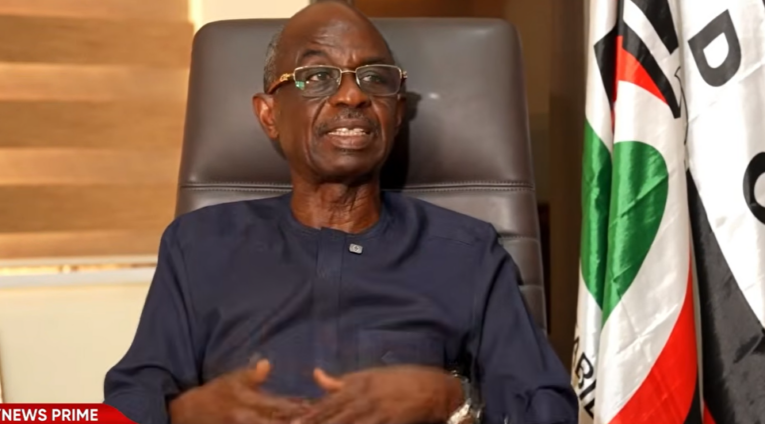
The National Chairman of the National Democratic Congress (NDC), Johnson Asiedu Nketia, has urged the police and other security agencies to investigate and take appropriate action against anyone found engaging in criminal conduct during internal political party elections.
He said allegations of vote-buying should not be treated merely as disciplinary matters for political parties, insisting that state institutions had a responsibility to enforce the country’s laws regardless of the political affiliation of those involved.
Speaking in an interview with JoyNews on Friday, November 13, Mr Asiedu Nketia said while it was not wrong for individuals to support party members, the practice became unacceptable when gifts and financial inducements were used to influence voting and secure political positions.
“It is not a bad thing if anybody wants to give party people something. But if it happens in a way around elections to suggest that we are just buying positions, then it is not acceptable at all in a democracy,” he said.
He called on the security agencies not to hesitate to act whenever they encountered conduct that breached criminal laws, arguing that party regulations alone were inadequate to deal with such offences.
“Once you are citizens and we are all subject to the laws of this country, when you want to subordinate the national laws to party laws, that’s not correct. Then you are part of the problem,” he said.
Mr Asiedu Nketia said political parties had their own responsibility to caution members and enforce internal rules, but that responsibility should not prevent state institutions from intervening where criminal conduct was suspected.
“The security services should be bold to proceed with whatever measures they want to do the same way as they deal with crime anywhere else,” he added.
He further argued that law enforcement agencies should not wait for the leadership of the NDC or the opposition New Patriotic Party (NPP) to take disciplinary action before responding to suspected criminal offences.
“If there is criminality, state institutions should not sit there and say that this is an NPP matter. It is an NDC matter. So you are waiting for NDC chairman to act this way. I’m waiting for NPP chairman to act this way,” he said.
Debate over vote-buying in party primaries
The comments come amid persistent concerns about the use of money and material inducements to influence delegates during internal party elections.
The issue attracted renewed public attention following allegations of inducements during the NDC parliamentary primary in Ayawaso East in February 2026. The Office of the Special Prosecutor opened an investigation into claims that television sets had been distributed to delegates. The allegations generated calls for stronger measures to protect the credibility of party elections.
The controversy also exposed a gap in Ghana’s electoral laws. While Section 33 of the Representation of the People Law, 1992 (PNDCL 284) criminalises bribery intended to influence voters in public elections, existing legislation does not expressly extend the same electoral offences to internal party contests.
In March 2026, Speaker of Parliament Alban Bagbin announced that a Private Members’ Bill seeking to address misconduct during party primaries and by-elections was before Parliament. The proposed reforms were intended to extend criminal sanctions to vote-buying and other forms of electoral malpractice in internal party elections.
Mr Asiedu Nketia’s latest comments therefore add to the debate over how political parties and state institutions should respond to alleged inducements in internal contests.
He said he was pleased that the party’s incoming leadership shared his concern about the monetisation of internal elections, expressing confidence that the fight against the practice would continue beyond his tenure as chairman.
He maintained that protecting the integrity of party elections was a responsibility that extended beyond party executives to the country’s law enforcement institutions.