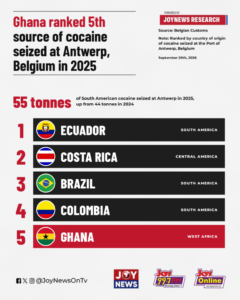
Ghana was the fifth-largest country of origin for cocaine seized at the port of Antwerp in Belgium in 2025, according to figures from Belgian customs. It was the only African country on a list otherwise made up of Latin American producer and transit states.
Belgian customs seized nearly 55 tonnes of cocaine at Antwerp last year, 24 per cent more than the 44 tonnes seized in 2024. Belgium’s Finance Minister, Jan Jambon, presented the figures on 21 January 2026. Ecuador, Costa Rica, Brazil and Colombia made up the rest of the top five, according to the breakdown reported by VRT, Belgium’s public broadcaster. VRT described Ghana as “de vreemde eend in de bijt”, the odd one out.
Antwerp is the main entry point for cocaine into Europe, and Belgian customs describe Belgium as the continent’s most important destination for cocaine shipped by sea. In customs figures, “country of origin” means the country where a container was loaded and shipped from, not where the drug was produced. None of the cocaine is grown in Ghana. It comes from the Andes and is hidden in legitimate Ghanaian exports.
Ghana’s ranking reflects a run of large seizures at Antwerp on cargo from Tema. In late November 2025, Belgian authorities found 2,829 kilogrammes of cocaine concealed in cassava flour shipped from Tema. In December, a further 1,158 kilogrammes of suspected cocaine was found in a shipment from Ghana. Together the two seizures come to about 4 tonnes, roughly 7 per cent of all the cocaine seized at the port in 2025.
Ghana’s appearance on the list is new. A major 2022 analysis of Europe’s cocaine market by the European Union’s drugs agency and Europol named Côte d’Ivoire, Senegal, Benin, Sierra Leone and The Gambia as West African countries linked to large seizures. It did not mention Ghana.
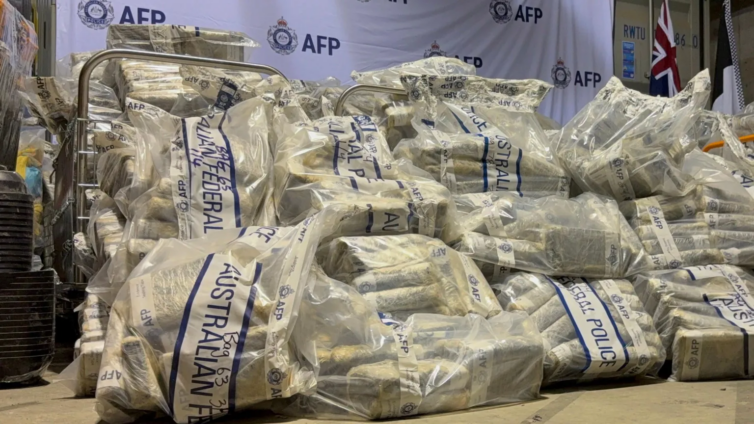
The Belgian figures are part of a wider pattern of seizures abroad traced to Ghanaian ports. In June 2025, Dutch customs seized 4,500 kilogrammes of cocaine hidden in a timber shipment from Tema at the port of Amsterdam, the largest seizure in the port’s history. In June 2026, Australian authorities announced the seizure of 320 kilogrammes of methamphetamine concealed in charcoal shipped from Ghana, valued at A$296 million. In September 2026, French customs at Dunkirk found nearly 3.9 tonnes of cocaine in a container of plastic waste from Ghana, part of it bound for Antwerp. French authorities valued that seizure at €225 million, about US$261 million.
A JoyNews tally counts 28 narcotics-related cases linked to Ghana since January 2025, 11 of them involving cocaine. The cocaine cases with published weights, at home and abroad, add up to about 15.8 tonnes. The four cases that came with official valuations total about US$768 million. The largest local seizure was 3.3 tonnes of cocaine intercepted at Pedu Junction in Cape Coast in March 2025, valued at more than US$350 million.
The Dunkirk seizure prompted President John Mahama to convene a meeting of security chiefs on 17 September. He directed an inter-agency task force to review Ghana’s systems for detecting narcotics and to submit, within two weeks, a roadmap for stopping drugs from moving through the country’s ports and borders. That deadline falls this week. The Presidency said ten people, including four officers of the Customs Division of the Ghana Revenue Authority, were being held while investigations continued.
All ten have since been put before the courts. Six, including a freight forwarder, the owner of the container and the four customs officers, were arraigned at the Kwabenya Circuit Court. Four others were arraigned at the Accra High Court and remanded until 13 October. They face charges including conspiracy to export narcotic drugs and exporting narcotics without a licence. The alleged mastermind, the Dutch fugitive Jos Leijdekkers, known as “Bolle Jos”, remains at large. According to the prosecution’s facts as reported, abnormalities were detected in the scanned images of the containers before export, but the containers were not subjected to further examination.
The Interior Minister, Muntaka Mubarak, said in August that intelligence-led operations had led to 217 arrests and 165 prosecutions over 20 months. Over the same period, authorities seized more than 8,500 kilogrammes of narcotics and 45.4 million tramadol tablets.
The matter reached Parliament on Tuesday, but the House declined to investigate it. Parliament had been recalled from recess at the request of the Minority, which then moved a motion for a bipartisan ad hoc committee to inquire into the seizures. The motion was filed by the First Deputy Minority Whip, Habib Iddrisu. It asked the committee to examine how the consignments were processed and cleared, which companies were involved, the state of investigations and prosecutions, port security, and the roles of state agencies.
The Speaker, Alban Bagbin, ruled the motion inadmissible under Standing Orders 5, 6 and 103(f). He said four substantive narcotics cases involving about 21 people are pending before the courts, and that the proposed inquiry overlapped with them. “The combined effects of undertaking this evaluation, assessment and investigation would be, at the end of the day, to determine the very issues that the court of competent jurisdiction is supposed to determine,” he said.
The Minority insists the matters it wants examined are not before any court. The Minority Leader, Alexander Afenyo-Markin, said the committee would have looked at container scanning, customs controls, port access, intelligence sharing and coordination between agencies, not at the guilt of any accused person. “The motion we filed before the House does not seek to try any accused person. It does not ask Parliament to determine criminal liability,” he said. He said the Speaker “got it wrong by using existing pending criminal proceedings to determine the scope and manner of the inquiry”. He called it “a sad day for democracy and parliamentary oversight” and said the Minority would not let the matter rest.
The concerns are not limited to the opposition. On 17 September, the day of the President’s meeting, the Interior Minister warned that Ghana’s foreign partners were becoming wary of sharing intelligence because of suspected insiders in the security services. “Our counterparts abroad are even beginning to doubt to give us some information because they trace it to an insider,” he said. “The very person that has been trained and trusted with that responsibility is now trading with it.” He named France and Australia as partners that were hesitant.
The Narcotics Control Commission has also acknowledged that the problem is changing. Its Director-General, Maxwell Obuba Mantey, said in May that Ghana was no longer only a transit point and now faced rising local consumption, and in July that the country was becoming a distribution hub. He said drug-related arrests rose by 197 per cent in 2025. NACOC officers have also warned that trafficking networks use fishermen to collect drugs from vessels on the high seas and bring them ashore. After arresting suspects linked to the Dunkirk shipment, the Commission said Ghana would not be allowed to become a safe haven, transit point or operational base for international drug trafficking organisations.