For most of the year, Elmina is a quiet historic fishing town where the rhythmic crashing of waves against the shore blends with the daily bustle of fishermen landing their catch and traders bargaining at the fish market.
But every July, the centuries-old town undergoes a remarkable transformation.
Its streets become alive with colour, music and celebration as thousands of residents, tourists and natives living abroad return home for the annual Edina Bakatue Festival, one of Ghana’s oldest traditional festivals.
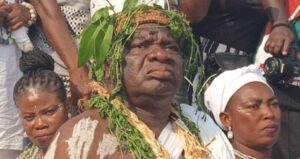
Nana Kwodwo Conduah VI, Omanhen of Elmina before the Bakatue rites last Tuesday
This year’s celebration, on the theme “Homecoming for Unity, Heritage and Development,” is once again breathing fresh life into the town, turning every corner into a blend of history, culture, tourism and business.
Long before the official opening of the week-long festivities on July 6, preparations had already transformed the community into a spectacle.
Across the principal streets of Elmina, walls have been beautifully decorated with colourful murals depicting the history, traditions and identity of the Edina people.
The artwork tells stories of the town’s rich past and gives visitors countless opportunities to stop, admire and capture memorable photographs.
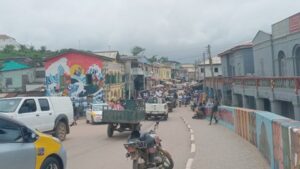
The streets are painted in preparation for the festival
One of the town’s most treasured landmarks, the Bethel Methodist Church, established in 1900, has also received a fresh coat of paint.
The renovation has restored the beauty of the over-a-century-old church while preserving its historic architecture, making it stand out proudly among the buildings that welcome visitors to the town.
Just a short distance away, the historic Elmina Castle continues to draw a steady stream of visitors.
Throughout the day, groups of local and international tourists could be seen entering and leaving the UNESCO World Heritage Site, guided through its centuries-old dungeons and corridors while learning about Ghana’s role in the trans-Atlantic slave trade.
For many visitors, the castle remains one of the first stops before joining the excitement of the Bakatue celebrations.
Beyond the historic landmarks, almost every available space in town has been transformed into a marketplace.
Trade boost
Temporary tents line the roads, with traders displaying colourful fabrics, clothing, footwear, beads, household items and local crafts, while food vendors prepare a variety of traditional meals to serve the growing number of visitors.
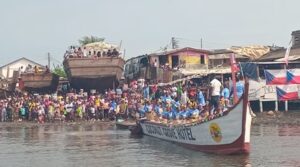
There was a regatta to add colour to the ceremony
For many of the traders, Bakatue is more than a festival; it is one of the biggest business opportunities of the year.
Portia Essien, who travelled from Kasoa to sell women’s dresses and cardigans, said patronage had been encouraging.
“People are buying, but last year’s sales were much better,” she said.
Awudu Salifu, who journeyed from Assin Praso with women’s dresses, expressed optimism.
“When your prices are moderate, people will always buy. Business is moving,” he said.
Rita Arthur, who is selling rice at the festival for the first time, said that although she hails from Elmina, she currently lives elsewhere and has decided to return home to do business during the celebrations.
“People are buying, but many still say last year’s festival attracted more customers,” she noted.
Nearby, first-time coconut seller Franks Ampong wore a smile as customers stopped by his stand.
“I am happy. Business has been encouraging,” he said.
The festival has also become a major homecoming for families.
Residents say many natives from Accra, Kumasi, Takoradi and other parts of the country have already returned, while more visitors from Europe, North America and other parts of the world are expected before the climax of the celebrations.
Although the official programme runs from July 6 to 12, activities have been underway for weeks.
Community groups and organisations have paid courtesy calls on the Omanhen of the Edina Traditional Area, while cultural performances and other traditional activities have set the tone for the celebrations.
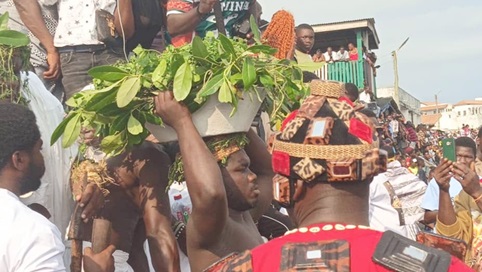
The highlight of the festival was the Bakatue, the lifting of the ban on fishing in the Benya Lagoon on Tuesday, when the omanhen performed the traditional rites.
The sacred ritual, regarded as the spiritual heart of the festival, has been observed for generations and symbolises thanksgiving, renewal and prayers for a successful fishing season.
Festival celebrates Ghana-Suriname connection
The Bakatue was graced bythe Surinamese Ambassador to Ghana, Fidelia Graand-Galon, who described Bakatue as a reminder of the deep historical connection between Ghana and Suriname.
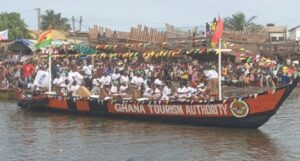
There was a regatta to add colour to the ceremony
She said she was amazed by the similarities between Ghanaian and Surinamese cultures, particularly through language, names and traditional practices preserved over generations.
She explained that words such as “Medase” and “Ago”, commonly used in Ghana, are also found in Surinamese culture, noting that she only discovered their Ghanaian origins when she first visited Ghana in 1997.
According to her, many Surinamese names, languages and traditions still reflect their African roots.
She mentioned names such as Afiba, Afi, Ajumako and Fanti as examples of the connections that continue to exist between Suriname and Africa.
Ms Graand-Galon also highlighted similarities between the canoe traditions of Ghana and Suriname, explaining that canoeing has been practised for hundreds of years among the
Maroon communities of Suriname, where it is known as “Site Boto”.
She said cultural celebrations such as Bakatue are important because they help preserve shared heritage and strengthen relationships between Africans on the continent and those in the diaspora.
“When I say Ago, we did not hear it from Ghana. We took it with us. We preserved it. We have to keep them safe,” she said.
Tourism and cultural identity
Speaking during the celebration, the Central Regional Director of the Ghana Tourism Authority, Charles Kwaku Boabeng, said festivals such as Bakatue remain important tourism platforms because they allow visitors to experience Ghana’s unique creative arts, traditional music, dance and the warmth and hospitality of the Ghanaian people.
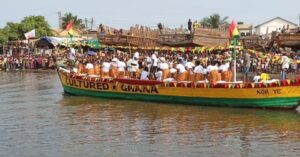
There was a regatta to add colour to the ceremony
He said such festivals contribute to tourism growth while promoting cultural identity and creating opportunities for local businesses.
Mr Boabeng assured the chiefs and people of Edina that the Ghana Tourism Authority would continue to support Bakatue and other festivals across the country because of their contribution to tourism development.
Although Tuesday’s Bakatue rites marked the spiritual centre of the celebration, activities have continued across Elmina ahead of Saturday’s grand durbar.
A series of events, including inter-schools competitions, singing contests, beauty pageants, sporting activities, health screening exercises and cultural performances, have kept residents and visitors engaged throughout the week.
The celebrations would be climaxed today with a colourful durbar of royalty, culture and pageantry.
For Elmina, Bakatue is more than an annual festival. It is a celebration of identity, a reunion of families, a boost to local businesses and tourism and a reminder that the town’s rich history continues to shape its future.
As the sounds of drums, traditional songs and laughter echo through the ancient streets, Elmina is once again proving why Bakatue remains one of Ghana’s most captivating cultural celebrations, where heritage is not only remembered, but proudly lived towards the betterment of the people.