Education must advance from mere knowledge acquisition
Education must advance beyond knowledge acquisition — Anis Haffar

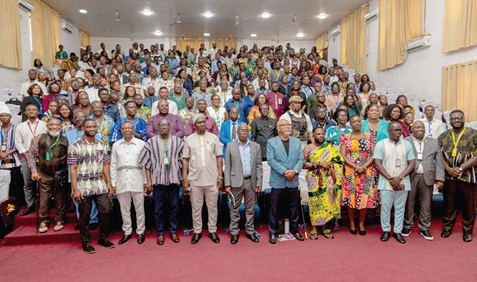
The Founder of Gifted and Talented Education (GATE) Institute, Anis Haffar, has said the provision of education must advance from mere knowledge acquisition of old to gaining of skills to solve societal problems.
He said today’s education must focus on the acquisition of specific skills that would solve pertinent global problems for the ultimate benefit of the people.
“Things are changing so fast around the world that we cannot afford to be passive, merely sitting to listen to lectures for the sole aim of receiving certificates. It pays to take serious inventory of the skills needed to address global challenges,” he stressed.
Conference
Mr Haffar made the remarks as the keynote speaker at the International Conference on Education and Humanities at the University of Skills Training and Entrepreneurial Development (USTED) in Kumasi in the Ashanti Region last Wednesday, May 27, 2026.
The three-day maiden conference, on the theme: “Building sustainable futures: The place of education, humanities and TVET” was organised by the Faculty of Education and Communication Sciences.
The conference brough together over 250 participants and 150 presenters, some from Nigeria, South Africa, India, United States of America (USA), with others from sister Ghanaian universities.
He mentioned that some skills had not yet been developed in classrooms and lecture halls, making the journey for solving problems in the society more interesting.
Wishful thinking
He noted that in second cycle schools, they thought of topics in science syllabus to chew and pass examinations, saying that “it never occurred to the educators at the time the need for skills to do fish farms to feed ourselves”.
He recounted an encounter with graduate students who returned to school for a master’s degree after failing to secure jobs regardless of the various lectures and courses they undertook at the undergraduate level.
“Academic degrees are very important but sill they are merely potentials.
The real accomplishments are in the capacity to use the degrees acquired in meaningful ways” Mr Haffar stated.
He indicated that employment opportunities were hard to come by for most people as the business of education had changed, stressing “today, we need people who identify problems and solve them”.
TVET
The Nkosuohene of Nyankyerenease, Nana Adu Gyamfi Kumanin Barima Kessie I, who was the special guest of honour, said over the years TVET had not received the attention it deserved.
He said many people had been made to believe that TVET was inferior to academic education, adding that “this mindset must change as TVET is important for economic growth and job creation”.
“A nation cannot reduce unemployment without investing in practical skills training. Therefore, governments, educational institutions and traditional authorities must work together to strengthen TVET education,” he said
The Vice-Chancellor, USTED, Professor Frederick Kwaku Sarfo, said a sustainable future was one in which values, wisdom, ethical commitments and critical faculties, among others, were transmitted across generations.
He stressed “it is a future in which the next generation inherits not only clean air and stable climate but the intellectual and moral equipment to use the gifts wisely”.
The Dean, Faculty of Education and Communication Sciences, Professor Faith Ben-Daniels, said all aspects of education, be it formal or informal must be designed today with the sole purpose of solving tomorrow’s challenges.