Ghana to assist undocumented citizens in Spain to secure residency under new amnesty.
The Government of Ghana has said it will assist undocumented Ghanaians in Spain to obtain the documents required to qualify for legal residency under Spain’s migrant regularisation programme.
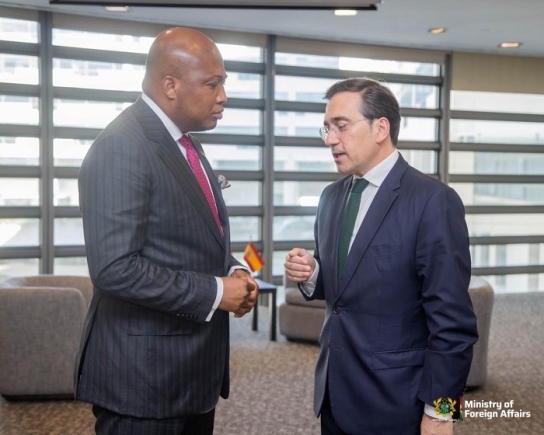
The Minister for Foreign Affairs, Mr Samuel Okudzeto Ablakwa, announced this after talks with his Spanish counterpart, Mr José Manuel Albares Bueno, in Barcelona on April 18, 2026. The meeting took place on the sidelines of the 4th High-Level Meeting of the “In Defence of Democracy Initiative” hosted by Prime Minister Pedro Sánchez.
Mr Ablakwa said Ghana would help facilitate access to the required official documents. He explained that Spain’s policy requires applicants to show they have no criminal record in their country of origin.
The move affects thousands of Ghanaians living and working in Spain without legal status. Spain finalised the amnesty on April 14, 2026, opening a path for many undocumented migrants to apply for residency. The policy applies to those who arrived before December 31, 2025, and can prove they have lived in the country for at least five months.
Applicants must show they do not pose a threat to public order or safety. Under the rules, the presence of a criminal record in a police report does not automatically lead to rejection, as each case is assessed individually.
Spain’s Migration Minister, Ms Elma Saiz, said online applications opened on April 16, with in-person submissions starting on April 20. The process will close on June 30. This leaves applicants with just over ten weeks to complete the process.
Immigration practitioners say securing the required documents can take time. A police clearance certificate from Ghana may take between one and four months, which could affect applicants working within the deadline.
Applicants must submit a criminal record certificate from their country of origin. The document must carry an Apostille stamp and be translated into Spanish by a sworn translator. Ghana’s Ministry of Foreign Affairs, which oversees the embassy in Madrid and the consulate in Barcelona, is expected to play a central role in issuing and authenticating these documents.
Mr Ablakwa also said Ghana and Spain had agreed to strengthen ties in maritime security and to pursue labour mobility agreements as soon as possible. He said this could create formal migration pathways beyond the current amnesty.
Spain has presented the regularisation as both a social and economic measure. Prime Minister Sánchez has said immigrants contribute about 10 per cent of the country’s GDP while accounting for about one per cent of public spending. Spain’s central bank and the United Nations have indicated that the country requires around 300,000 migrant workers each year to sustain its welfare system.
Once an application is submitted, any pending expulsion orders are suspended. Applicants will receive temporary authorisation, allowing them to work and access public healthcare while their cases are processed.
Mr Ablakwa described the discussions in Barcelona as constructive and said the policy offers an opportunity for migrants to regularise their status while supporting Spain’s labour needs.
He added that Ghana and Spain reaffirmed their shared position on promoting global peace and stability.